

By the Twende Kenya Travel Desk
A day hike on Ngong Hills costs KES 200 for citizens, and as of 2026 you'll need M-Pesa or a card at the gate — cash isn't accepted anymore. The full seven-peak traverse now requires a KFS ranger escort, which wasn't always strictly enforced, and September sits right in the middle of the dry season that makes the ridge worth the climb in the first place. Here's what we found when we went up last week, plus everything that's changed since the last round of blog posts on this trail.
What does it actually cost to hike Ngong Hills in 2026?
Kenya Forest Service manages the reserve, and the fee structure has three tiers depending on residency status. You'll need your National ID, Alien Card, or passport at the gate to prove which rate applies to you — they do check.
| Category | Adult | Child |
|---|---|---|
| Kenyan citizens & East African residents | KES 200 | KES 50 |
| Other foreign residents | KES 400 | KES 100 |
| Non-residents | KES 600 | KES 150 |
| Camping (per night) | KES 650 | KES 100 |
| Ranger escort | KES 1,000 per group | — |
| Cycling | KES 100 | — |
| Horse riding | KES 300 | — |
The one thing that trips people up: payment is cashless now, M-Pesa or debit/credit card only at the gate. If you're used to older posts about this trail quoting cash prices in dollars, ignore them — that's not how it works in 2026.
Do you actually need a ranger for Ngong Hills?
For the full seven-peak traverse, yes — it's mandatory now, not optional. Ngong Hills had a real reputation for isolated robbery incidents on the ridge in past years, and KFS responded by increasing ranger presence and requiring an armed escort for anyone doing the complete route from the main gate to Kona Baridi. The ranger fee is KES 1,000 per group (not per person), which is easy to miss if you're only reading the entrance-fee page and not the safety notes. If you're just walking the shorter loop near the main gate rather than the full traverse, escort requirements are more relaxed, but honestly, we'd still take one — it's a flat fee split across your group and they know the terrain, the birds, and the best spots to stop for photos.
How do you get there without a car?
This is the part most guides skip entirely. From Nairobi CBD, matatu route 111 leaves from around Agro House and drops you in Ngong town — expect to pay a fraction of what a taxi costs and budget around 45 minutes to an hour depending on traffic through Karen and Ngong Road. From Ngong town, the main gate is about 2.5km away. You can walk it, but most people grab a boda-boda for around KES 100 rather than starting the hike already tired. If you're driving yourself, there's parking at the main gate, and it's roughly 22-25km from the CBD depending on your route.
Full traverse or the shorter loop?
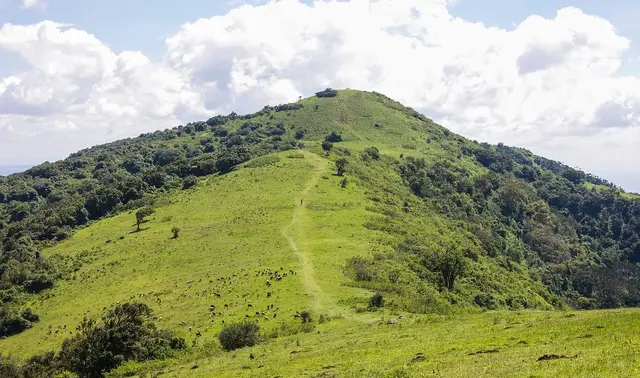
The full seven-peak traverse runs about 12km from the main gate to Kona Baridi and takes 4-6 hours depending on your pace and how often you stop for the view — which, fair warning, you will stop for constantly. On a clear day you get the Rift Valley falling away on one side, Nairobi's skyline on the other, Mount Suswa in the distance, and the Ngong Wind Farm turbines turning along the ridge itself. It's a point-to-point route, not a loop, so you'll need to arrange transport back from Kona Baridi or start early enough to retrace your steps. If six hours sounds like a lot, there's a shorter out-and-back option from the main gate that gets you two or three peaks and most of the view without the full commitment — good for a half-day if you're short on time or hiking with kids.
Why September works
Ngong Hills has two dry windows — January to March, and July through October — and both are genuinely better for this hike than the alternative. The rains between April and June, and again in November and December, turn the ridge trail slick and can hide the views entirely behind cloud. Right now, in September, you're inside that second dry stretch: clearer skies, firmer footing on the steeper sections, and a much better shot at the kind of visibility that makes the climb worth it. It's also shoulder season for the trail generally, so weekday mornings especially tend to be quieter than the Saturday crowds.
What to pack
- At least 2-3 litres of water per person — there's no water source on the ridge itself
- Sun protection: the exposed ridge has almost no shade above 2,200m
- Proper closed hiking shoes, not sneakers — the volcanic soil gets loose and slippery on the descents
- Cash is out, but keep your M-Pesa loaded or a card on you for gate fees
- A light jacket for the wind — the ridge earns its wind-farm reputation
Frequently asked questions
How long does the Ngong Hills hike take?
The full seven-peak traverse takes 4-6 hours covering about 12km. The shorter loop from the main gate can be done in 2-3 hours.
Is Ngong Hills safe to hike in 2026?
Yes, with the mandatory ranger escort for the full traverse. KFS increased security presence on the ridge after past isolated incidents, and the armed-escort requirement is part of that response — it's a real requirement now, not a suggestion.
Can I pay cash at the Ngong Hills gate?
No. As of 2026, KFS only accepts M-Pesa and debit/credit card payments at the gate.
What's the best time of year to hike Ngong Hills?
The dry seasons — January to March and July to October — give you the clearest views and the most stable trail conditions. September falls comfortably inside that second window.
How do I get to Ngong Hills from Nairobi without driving?
Take matatu route 111 from around Agro House in the CBD to Ngong town, then a boda-boda (about KES 100) for the last 2.5km to the main gate.
Pair this with a morning at Nairobi National Park if you want two very different Nairobi day trips in one weekend, or if hiking is turning into a habit, our Mount Kenya route guide covers what a much bigger climb involves. For a different kind of active day out closer to Nairobi, Hell's Gate National Park is the one where you cycle among zebra instead of walking a ridge.
For the official position on fees, rules, and forest conservation status, the Kenya Forest Service's Ngong Hills Forest page is the authoritative source, and rates there are always the most current.

Comments 0
Join the conversation. No account needed.