

By the Twende Kenya Travel Desk
Short answer: if you want the clearest skies and the driest trails on Mount Kenya, aim for late June through early October, or January into early March. We're squarely in that first window right now, and September is one of the two or three best months of the entire year to go — which is exactly why it's worth sorting out which route suits which month before you book anything.
So When Exactly Is the Best Time to Climb Mount Kenya?
Mount Kenya has two dry windows: mid-December to early March, and late June to October. The second one is longer and, on the Sirimon and Chogoria sides, noticeably drier underfoot. Between the two windows sit the long rains (roughly late March to May) and the short rains (late October to mid-December), when the Naro Moru "vertical bog" section earns its nickname and cloud cover on Point Lenana can sit in for days at a time.
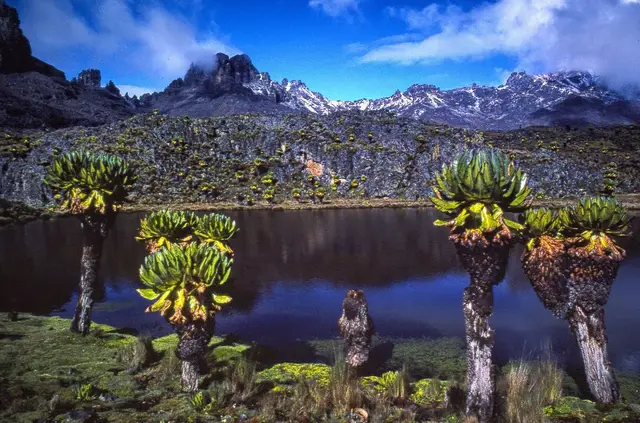
We'd time a trip for this September-October window specifically because the moorland wildflowers (giant lobelias, groundsels) are usually at their best after the long rains have fed them but before the short rains turn the upper trails to mud again. A guide we spoke to in Nanyuki put it simply: "June to September, you get the mountain. October, you're racing the rains a bit."
Which Route Should You Actually Take, and When?
Mount Kenya National Park has three main trekking routes to Point Lenana (4,985m), the walkable summit most visitors are after — Batian and Nelion, the two true rock peaks, need technical climbing and a completely different kind of trip.
- Sirimon — the driest of the three routes and the gentlest ascent profile, which also makes it the easiest one to underestimate on the acclimatisation front. Best June to October and January to February.
- Chogoria — the most scenic by a wide margin (the Gorges Valley and Lake Michaelson views are worth the extra day alone), but it takes longer to dry out after rain than Sirimon does. Best July to September.
- Naro Moru — the shortest and steepest route, popular for a fast up-and-down, but its infamous bog section turns genuinely unpleasant outside the dry windows. Best January to February and July to September.
Most people we'd recommend to now go up Sirimon and down Chogoria (or vice versa) — a 4-to-5-day traverse that avoids repeating scenery and spreads the altitude gain more sensibly than a straight Naro Moru dash.
What Does Climbing Mount Kenya Actually Cost in 2026?
This is where a lot of older guides online are quoting numbers that are now out of date. Kenya Wildlife Service overhauled its conservation fee structure on 1 October 2025 — the first major revision in nearly two decades — so if you're reading a guide still citing US$40 non-resident park fees, it's stale.
| Fee category | Rate |
|---|---|
| Non-resident adult (park entry, per 24 hrs) | USD 70 |
| African citizen, non-EAC (per 24 hrs) | USD 30 |
| Kenya resident (per 24 hrs) | KES 1,100 |
| East African citizen (per 24 hrs) | KES 800 |
| Technical climbing permit (Batian/Nelion), non-resident | USD 30/day extra |
| Point Lenana trekking permit | Included in daily park entry |
| Public campsite, non-resident | USD 20/night |
Tickets are bought through the eCitizen platform and are valid for a rolling 24 hours from entry, so a 4-day trek means paying for 4 days of park entry, not a flat one-off fee — factor that into your budget alongside guide, porter, hut, and transport costs, which most Nanyuki-based operators bundle into packages roughly in the $700-$1,300 range for a 4-to-5-day Point Lenana trek depending on route and group size.
How Do You Get to the Trailheads From Nairobi?
All three main gates are reachable by road in half a day from Nairobi. Nanyuki, the usual staging town for Sirimon and Naro Moru, is about a 3-hour drive north on the A2, with frequent shuttle and matatu services running from Nairobi's Roysambu/Thika Road stages for a few hundred shillings if you're doing this independently rather than through a tour operator. Chogoria's gate is reached via the town of the same name on the mountain's eastern side, roughly 4-5 hours from Nairobi through Embu.
Most first-timers we'd point toward a licensed operator rather than going fully independent — porters and a guide aren't just for comfort here, altitude sickness on the push to Point Lenana is genuinely common, and having someone who knows the weather patterns on your specific route that week is worth more than it sounds.
What Should You Pack for a September Climb?
- Layered clothing — mornings at the trailhead are warm, summit night can drop below freezing
- A proper 4-season sleeping bag if you're using the mountain huts rather than a full expedition tent
- Broken-in hiking boots, not new ones — the Naro Moru bog and Sirimon scree both punish blisters
- Water purification tablets or a filter — streams are plentiful but untreated
- Sun protection — equatorial UV at altitude is stronger than most people expect, even with cloud cover
Frequently Asked Questions
Do I need climbing experience to reach Point Lenana?
No technical climbing skill is required for Point Lenana — it's a high-altitude trek, not a rock climb. Batian and Nelion are a different matter and require rope work, a technical guide, and separate permits.
How many days does the Point Lenana trek take?
Most itineraries run 4-5 days, including acclimatisation time. Attempting it in 3 days is possible but raises your altitude sickness risk considerably, especially on Naro Moru.
Is September a good month to climb Mount Kenya?
Yes — September sits inside the longer of the mountain's two dry windows and is one of the more reliable months for clear summit views on all three main routes, particularly Chogoria and Naro Moru.
How much does a guided Mount Kenya trek cost in 2026?
Budget roughly USD 700-1,300 per person for a 4-5 day guided Point Lenana trek including park fees, hut or camping fees, guide, cook, and porters, depending on route, group size, and operator.
What's the closest big town to start from?
Nanyuki, for the Sirimon and Naro Moru gates. It has hotels, gear rental shops, and licensed tour operators, and is about 3 hours from Nairobi by road.
Planning to combine the mountain with the rest of Laikipia and Central Kenya? Have a look at our guides to Ol Pejeta Conservancy and The Ark and Treetops in the Aberdares — both make an easy add-on before or after a Mount Kenya trek, and Samburu National Reserve is a reasonable extension north along the same A2 corridor if you have an extra couple of days.
For the official, current fee schedule and eCitizen booking portal, go straight to the source: eCitizen — Kenya Wildlife Service park entry.

Comments 0
Join the conversation. No account needed.