

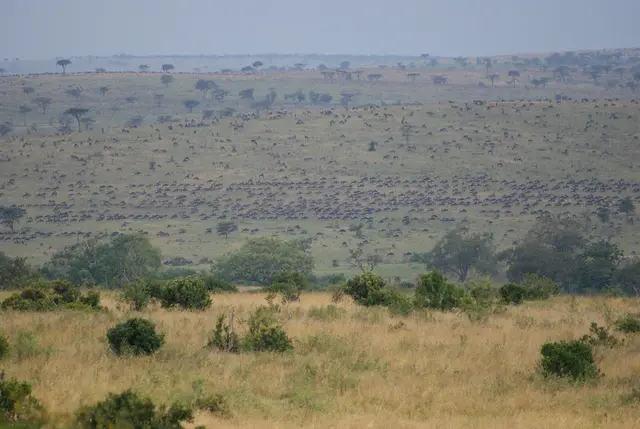
Short answer: which Maasai Mara gate you use matters almost as much as when you go, and in September 2026 it's genuinely worth the extra ten minutes of research. Entry fees jumped to USD 200 a day for non-residents on 1 July, and the gate you pick determines whether your morning drive to a river crossing is fifteen minutes or an hour and a half.
We get asked "which gate is best" more than almost any other Mara question, so here's the practical version: current fees, what the six gates actually connect to, the 12-hour rule that trips up a lot of first-timers, and where to sleep depending on your budget and which crossing points you're chasing.
Maasai Mara entry fees in 2026: what you'll actually pay
The Maasai Mara National Reserve is run by the Narok County Government, not Kenya Wildlife Service, and it sets its own fee schedule separately from KWS parks like Amboseli or Nakuru. Fees rose on 1 July 2026 for the high season and stay elevated through December:
| Category | Jan–Jun 2026 | Jul–Dec 2026 |
|---|---|---|
| Non-resident adult | USD 100/day | USD 200/day |
| Non-resident child (9–17) | USD 50/day | USD 50/day |
| East African resident adult | KES 2,500 | KES 5,000 |
| Kenyan citizen adult | KES 1,500 | KES 3,000 |
| Kenyan citizen child | KES 300 | KES 500 |
| Children 8 and under | Free | |
If you're booking September or October travel through a tour operator, this fee is almost always already built into your package price, but it's worth confirming which season's rate they quoted you back when you paid your deposit.
Which of the six gates should you actually use?
The reserve has six official entry points, and they don't all put you in the same part of the ecosystem:
- Sekenani Gate — the main gate, reached directly off the Narok–Sekenani road. Busiest, most straightforward if you're driving yourself, but a longer haul west to the river crossing points.
- Oloolaimutia Gate — a few kilometres from Sekenani on the hilly eastern edge, with the tightest cluster of nearby camps and the shortest average morning commute of the eastern gates.
- Talek Gate — sits right on the Talek River, roughly central, and is the fastest eastern-side route into the migration action once herds are moving through the middle of the reserve.
- Musiara Gate — the northern gate near Musiara Swamp, closest if you're staying in the Mara North Conservancy area.
- Oloololo Gate — the entrance to the Mara Triangle, the western third of the reserve managed separately by the Mara Conservancy. Fewer vehicles, noticeably better roads, and the most reliable access to the classic Mara River crossing points.
- Sand River Gate — the least-visited gate, tucked in the reserve's southeastern corner against the Tanzania border. This is where the migrating herds physically enter the ecosystem each year, often weeks before the bigger Mara River crossings.
If watching an actual river crossing is your one priority, the Mara Triangle side (via Oloololo, or staying in a camp that gives you Triangle access) puts you closest to the water most consistently. If you're chasing the very first arrivals of the season, Sand River Gate is the one nobody else is talking about.
Where's the migration right now, in September 2026?
We covered the week-by-week movement in more detail in our piece on the migration reaching the Mara, but the short version for anyone planning a trip this month: the window running from mid-August through late September is the strongest for Mara River crossings, with predators already positioned along the banks. Nothing about a wildebeest crossing runs on a schedule, so treat any specific date you read online as a probability, not a booking guarantee.
The 12-hour rule catches out a lot of first-timers
Every ticket is valid from 6am to 6pm on the day of entry, full stop, regardless of what time you actually arrived at the gate. There's one piece of grace built in: if you're leaving the reserve the following morning, you can exit by 10am without paying for a second day. Push past 10am, even for one last game drive, and you'll be charged the full daily rate again on the way out. Private conservancies bordering the reserve, like Mara North, Naboisho and Olare Motorogi, aren't bound by this rule and can run night drives — the 6am–6pm cutoff applies only inside the national reserve itself.
Where to stay, by gate and budget
Camp choice should follow crossing-point access first, budget second. A rough guide:
- Sekenani Gate area (budget–mid): Ashnil Mara Camp and Mara Sopa Lodge sit within easy reach, generally USD 120–350 a night for a mid-range tented camp with full board.
- Sekenani Gate area (luxury): JW Marriott Masai Mara Lodge, a short drive from the gate, runs well into the USD 400–1,500+ luxury bracket.
- Talek Gate area: Mara Intrepids sits directly on the Talek River, putting migration-season guests within realistic range of the central crossing points.
- Oloololo Gate / Mara Triangle: Kichwa Tembo Tented Camp is the classic pick for Triangle access, with the better road network working in your favour when a crossing gets called in on the radio.
- Oloolaimutia Gate area (budget): Enchoro Camp and Rhino Tourist Camp are reliable budget options in the USD 50–120 range, useful if you're prioritising cost over crossing-point proximity.
Whichever camp you book, call ahead specifically about September and October availability — this is peak season, and the properties nearest the crossing points fill up months in advance.
FAQ: Maasai Mara gates, fees and the migration
Do I need to pick a gate in advance, or can I choose on arrival?
Most independent travellers pick a gate by choosing where they're staying first — your camp or lodge will tell you which gate to use, since it's usually the nearest one to their property.
Is the Mara Triangle a different park with a separate ticket?
No — it's the western third of the same Maasai Mara National Reserve, just managed by the Mara Conservancy rather than Narok County directly. Standard reserve fees apply either way.
Which gate is closest to the most famous crossing points?
Oloololo Gate, on the Mara Triangle side, gives the most consistent access to the well-known central Mara River crossing points.
Are September 2026 fees still USD 200 a day for non-residents?
Yes — the USD 200/day non-resident adult rate applies from 1 July through 31 December 2026, covering the entire peak migration season.
Can I visit for just a few hours to save money?
No — the reserve charges a full day rate regardless of how many hours you spend inside, with the 10am grace period on exit being the only partial exception.
For more Rift Valley planning, our guides to Lake Nakuru National Park and Amboseli National Park cover two other parks worth pairing with a Mara trip if you have the extra days.
By the Twende Kenya Travel Desk.
Comments 0
Join the conversation. No account needed.