

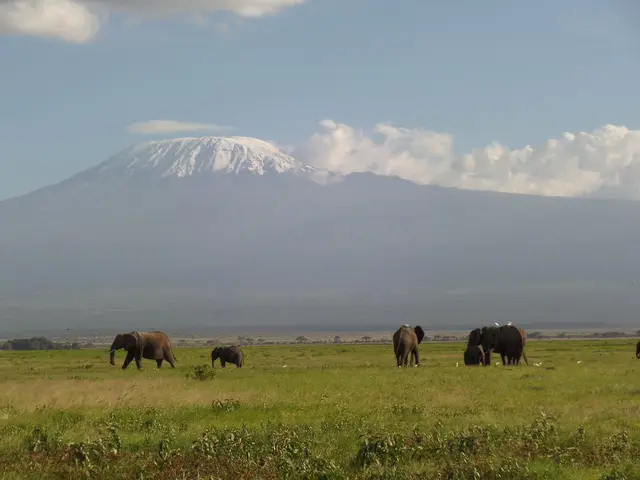
There's a specific image most people have in their head before they've ever set foot in Kenya: a line of elephants crossing dusty plains with a snow-capped Kilimanjaro floating behind them. That photo is real, it's not photoshopped, and the place to get it yourself is Amboseli National Park, on the Tanzanian border in southern Kenya.
Why the elephants here are different
Amboseli holds one of Africa's largest and most studied elephant populations — somewhere in the range of 1,600 to 1,900 individuals, tracked by researchers for decades, which means many of the older matriarchs and bulls here are individually known and named. You're not just seeing elephants; you're seeing herds with real social structure and history, moving across open swampland and dry lakebed in family groups that can run to dozens of animals. Because the terrain is so open compared to bushier parks, sightings tend to be long, close, and unhurried rather than a brief glimpse through foliage.
The mountain is the other half of the deal
Kilimanjaro sits just 40 kilometres south, across the border in Tanzania, and on a clear morning it rises out of the haze looking impossibly close. It isn't always visible — cloud builds through the day, so early morning, before around 9am, is consistently your best window, and the dry months (June to October, and January to February) give you noticeably better odds than the wetter stretches of the year. If a Kilimanjaro photo matters to you, plan for at least two mornings in the park rather than one, since weather can simply not cooperate on any given day.
Getting there
Amboseli is roughly 4-4.5 hours from Nairobi by road, and there are two main routes. Via Namanga, on the Nairobi-Arusha highway, it's about 140km to the Meshanani Gate — the most popular entry point. The alternative, via Emali on the Mombasa Road, runs to the Iremito or Kimana gates and takes a bit longer at around 215-240km. Whichever way you go, a 4x4 is genuinely useful rather than optional — in-park roads get rough, especially after rain. If you'd rather skip the drive entirely, scheduled flights from Nairobi's Wilson Airport reach Amboseli's airstrip in about 35 minutes, which is worth pricing out if you're short on time or coming straight off an international flight.
Fees and timing
Entry fees run on a tiered system — non-resident adults pay in the region of USD 70-90 per day depending on current rates (these have been subject to review, so it's worth checking the latest KWS rate before you travel), with lower tiers for African citizens, Kenya residents, and East African citizens. Fees cover a 24-hour cycle rather than a calendar day. Most operators recommend budgeting two full days in the park rather than a rushed single-day visit — it gives you two sunrise and sunset light cycles, a real shot at clear Kilimanjaro views, and time to explore beyond the busiest central swamp area.
Where to stay
Options cluster both inside and just outside the park boundary. Amboseli Sopa Lodge sits within the park with unobstructed mountain views on a clear day. Outside the gates, Kibo Safari Camp, Sentrim Amboseli, Tulia Camp, and Kilima Safari Camp all offer a range from mid-range tented camps to more polished lodges, generally at a lower price point than staying inside the park itself. If photography is your main goal, ask specifically about rooms or camps with a clear, unobstructed sightline toward Kilimanjaro — not every property has one, even ones marketed on the view.
Beyond the obvious shot
It's easy to treat Amboseli purely as an elephant-and-mountain photo op and move on, but the park rewards a slower pace. The swamps support healthy populations of buffalo, hippo, and a genuinely good range of birdlife, and the surrounding Amboseli ecosystem — including community conservancies bordering the park — is part of a wider effort to keep wildlife corridors open between here, the Chyulu Hills, and Tsavo. Ask your guide about visiting a Maasai community project nearby if you have the extra half-day; several operate responsibly and give useful context for the landscape you've just spent two days driving through.
Worth the detour
Amboseli earns its reputation honestly. The elephants are genuinely exceptional, the mountain backdrop is genuinely that dramatic on a good morning, and unlike some of Kenya's more remote parks, it's reachable enough from Nairobi to fit into a realistic itinerary. Give it two days if you can — one clear Kilimanjaro sunrise is worth the extra night on its own.
A few practical notes
Dust is the defining feature of Amboseli's terrain — the dry lakebed that gives the park its name kicks up fine, pale dust that gets into everything, so pack a dust-proof bag for camera gear and expect vehicles (and clothes) to come back noticeably dirtier than at most other parks. Bring a longer lens if wildlife photography is the priority, since the open terrain means animals are often visible at greater distances than in denser bush parks. And because mornings can be genuinely cold before the sun clears the horizon, a warm layer for the first game drive is worth packing even though you'll be shedding it by mid-morning.
Comments 0
Join the conversation. No account needed.