

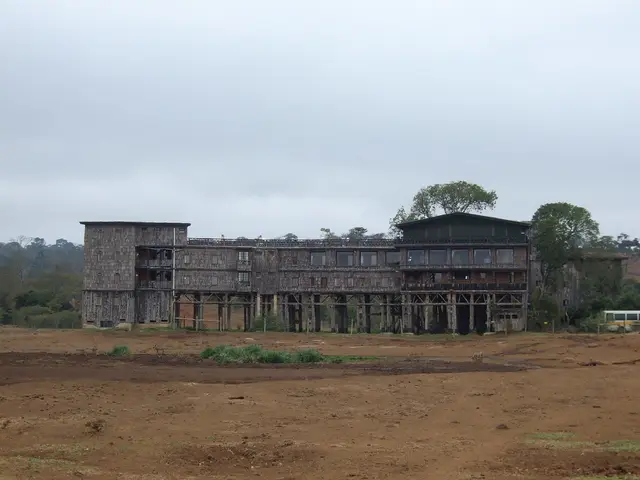
Most Kenyan safaris put you in a vehicle, moving toward the animals. The Aberdare Salient flips that entirely. You check into a lodge built on stilts around a floodlit waterhole or salt lick, settle in with a drink, and let elephants, buffalo, and — if you're lucky — a bushpig or genet come to you through the night. It's one of the more unusual wildlife experiences in Kenya, and it's a genuinely easy add-on from Nairobi.
Two lodges, one idea
The Salient — a lower-altitude rainforest belt on the eastern edge of Aberdare National Park — is home to two famous lodges built specifically around this concept. The Ark is an ark-shaped lodge overlooking a natural waterhole where elephant and buffalo show up most nights, drawn by the water and mineral licks. Treetops, at 1,966 metres and tucked into dense forest, is the older and more historically loaded of the two: this is the lodge where the then-Princess Elizabeth was staying in 1952 when she learned of her father's death and, in effect, became Queen while up a tree in Kenya. Both lodges work the same way — you arrive by day, settle in, and the wildlife-watching happens from viewing platforms and lounges after dark, no game drive required.
Beyond the waterhole lodges
Aberdare National Park itself is bigger and wilder than the two famous lodges suggest — moorland, bamboo forest, and dense rainforest climbing up toward the Aberdare Range's higher reaches. It's also home to two of Kenya's most dramatic waterfalls: Karuru Falls, which drops in three stages for a combined 273 metres, and nearby Gura Falls, which free-falls roughly 300 metres. If you have a vehicle and a full day, both are worth the detour beyond the Salient's lodges, especially in the wetter months when they're at full volume.
Getting there
Aberdare is roughly 150-180km from Nairobi depending on which gate you're headed for — call it about three hours by road. The standard route runs up the A2/Thika Superhighway to Nyeri, then along the Nyeri-Nyahururu road toward Mweiga and the Treetops Gate. If you're not self-driving, matatus and buses run from Nairobi to Nyeri, from where a taxi or boda boda covers the last stretch to the gate. There's also a short flight option — about 40-50 minutes from Nairobi's Wilson Airport to Mweiga airstrip, followed by a 15-20 minute road transfer — worth considering if you're combining this with a tighter overall itinerary.
Fees and timing
Entry fees rose meaningfully in October 2025 when KWS standardized a 24-hour entry system across its parks — East African citizen and resident rates roughly doubled from where they'd sat for nearly two decades, so budget for the current published rate rather than an older figure you might have seen quoted elsewhere. For timing, the dry months — January to February and June to October — give the best combination of manageable roads and reliable wildlife activity, while the wetter months bring lusher forest and the waterfalls at their most dramatic, at the cost of trickier driving. April and May are generally worth avoiding; that's when in-park roads get genuinely difficult.
The rhinos most visitors don't expect
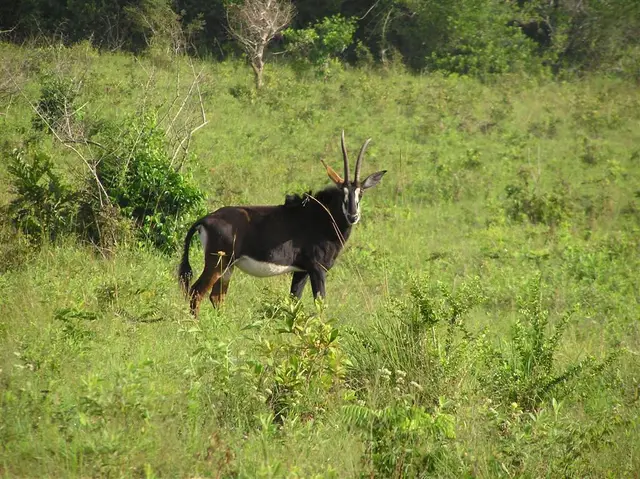
Aberdare holds Kenya's second-largest population of eastern black rhino, concentrated in the Eastern Salient and protected by an electric perimeter fence that's brought poaching down close to zero in recent years — a genuine conservation success story that doesn't get nearly as much attention as the Mara's or Amboseli's wildlife. Aberdare is also one of the few parks in Kenya where, on the right day, you could technically tick off all of the Big Five in a single visit. Higher up, the bamboo zone and moorland shelter species you won't see on a typical savanna safari at all — giant forest hog, eland, serval, and the critically rare mountain bongo, one of Africa's most endangered large mammals, surviving in only a handful of forest fragments including this one.
What to actually pack
Because the Salient sits at altitude and the lodges are built for evening viewing rather than daytime comfort, temperatures drop hard after dark — bring a proper warm layer even if you were sweating on the drive up. Most lodges also run a fixed check-in window (usually early to mid-afternoon) since day access to the Salient area is tightly controlled around lodge transfers, so build that into your schedule rather than assuming flexible arrival times.
Worth the stay
The Ark and Treetops aren't trying to compete with a Mara or Amboseli safari, and they shouldn't be judged against one. What they offer is something different: a slower, quieter kind of wildlife encounter, framed by history at Treetops and by sheer waterhole drama at The Ark, all within a half-day's drive of Nairobi. If your itinerary has room for one night that isn't a standard game drive, this is a strong contender.

Comments 0
Join the conversation. No account needed.