

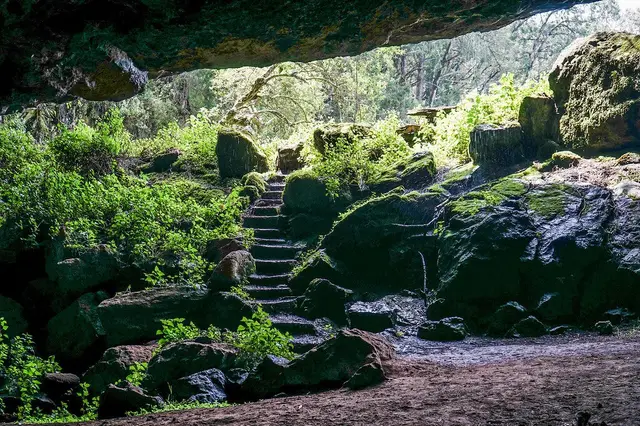
Some wildlife behaviours sound made up until you've actually seen them described by researchers who've studied them for years. Mount Elgon's salt-mining elephants are one of those: herds that make their way into pitch-dark volcanic caves at night, navigating entirely by memory and touch, to scrape mineral-rich salt off the cave walls with their tusks. It's one of the most genuinely strange wildlife phenomena in Kenya, and it's the main reason Mount Elgon National Park, on the Kenya-Uganda border in the far west, is worth the long drive to reach it.
Kitum Cave
Kitum is the most famous of Mount Elgon's several caves, carved not by water but partly by the elephants' own mining activity over generations, alongside natural volcanic processes. Guided visits take you into the cave to see the tusk-scored walls directly — a genuinely different kind of wildlife evidence than a footprint or a distant sighting, since you're looking at the literal marks left by the animals' feeding behaviour. Bring a proper torch even if your guide has one; the cave interior is dark enough that backup light matters.
The mountain itself
Beyond the caves, Mount Elgon is one of Kenya's under-visited trekking destinations — an extinct shield volcano with one of the largest calderas in the world, its slopes running through montane forest, bamboo zones, and high-altitude moorland on the way up to Koitoboss Peak on the Kenyan side. It's a serious multi-day trek for anyone wanting the summit, but shorter day walks through the lower forest zones are accessible to less ambitious visitors and still deliver genuinely dramatic scenery.
Getting there
The main Kenyan-side entrance, Chorlim Gate, sits about 35km from Kitale, the closest town of any size. From Kitale, a taxi to the park and back runs roughly USD 30, or a boda-boda roughly USD 10-15 for the round trip — either is more practical than trying to self-drive the final stretch if you're not already in your own 4x4. From Nairobi, it's a full 420km, roughly 8-hour drive via tarmac road to Kitale, then onward on murram (gravel) roads to the gate — genuinely one of the longer overland trips to any Kenyan park, which is exactly why it sees so few visitors relative to its actual attractions.
Fees and a practical payment warning
Entry fees are quoted inconsistently across sources — figures from USD 25 to USD 50 per adult per day show up depending on where you look, so confirm the current rate directly with KWS or your operator before you travel rather than relying on an older published number. More usefully: bring Kenyan shillings as backup regardless of the official rate, since the card and dollar payment terminals at this gate have a documented history of not working reliably. Showing up with only a card and no cash fallback here is a real risk in a way it generally isn't at Kenya's busier, better-resourced parks.
When to go
Dry season — roughly December to March and June to September — gives the most reliable trekking and cave-access conditions; Mount Elgon's slopes get significant rainfall outside those windows, and the murram access roads deteriorate accordingly.
Worth it if you're already in western Kenya
Mount Elgon isn't a convenient add-on to a standard Kenya itinerary — it's genuinely out of the way, tucked against the Uganda border far from the coast or the classic safari circuit. But if you're already deep into a western Kenya loop through Kakamega, Kisumu, or Kericho, and you want one more destination that nobody else on your trip has heard of, the salt-mining elephants and the sheer scale of the caldera make the extra distance worth covering.
A note on safety and guides
Because Mount Elgon sees relatively few visitors and sits in a remote border area, hiring a licensed local guide isn't just recommended, it's the standard and sensible way to visit — for cave access, for trekking routes, and for general orientation in a park with far less visitor infrastructure than Kenya's headline destinations. Arrange this through KWS directly or through an established Kitale-based operator rather than informally at the gate.

Comments 0
Join the conversation. No account needed.