

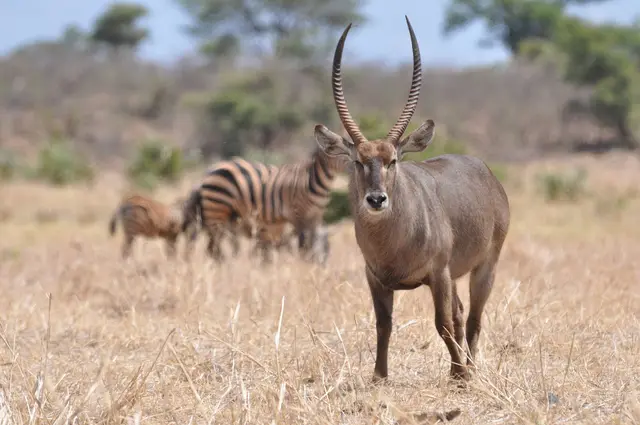
Meru National Park has one of the best backstories in Kenyan tourism — it's the setting for "Born Free," the true story of Elsa the lioness raised and released here by conservationists George and Joy Adamson in the 1960s — and yet it remains one of the least-visited major parks in the country. That's not a knock on the park. It's the reason to go.
The rhino sanctuary
Meru's headline wildlife draw is its 80 square kilometre rhino sanctuary, fenced and monitored around the clock, home to roughly 40 white rhino and 20 black rhino. Because the population is so closely protected and well habituated to visitor vehicles, sightings tend to be excellent — genuinely one of the more reliable rhino encounters in Kenya. The sanctuary drive is included in standard park entry with no separate ticket required, which isn't the case at every rhino sanctuary in the country.
Beyond the rhinos
Meru's landscape is lusher and more varied than the classic dry-savanna image most people carry of Kenyan parks — 13 rivers and numerous streams cross the park, feeding riverine forest, open grassland, and swampy patches that support a genuinely wide range of habitats in a relatively compact area. Elephant, buffalo, lion, leopard, and reticulated giraffe are all present, along with strong birdlife tied to the park's water sources.
Getting there
Meru covers 870 square kilometres in central-eastern Kenya, roughly 350km from Nairobi, with Murera Gate as the main access point — about a 5-hour drive. Daily scheduled flights from Nairobi's Wilson Airport reach several of the park's airstrips directly, each with its own gate for arriving visitors, and given the driving distance, flying is worth seriously considering if your time in Kenya is limited.
Fees, current as of 2026
Non-resident adult entry runs USD 70. Kenya has moved most park payment systems to card, M-Pesa, or advance online booking rather than cash at the gate, and Meru's entrance gates are set up for electronic payment accordingly — worth confirming your payment method works before you arrive rather than assuming a fallback option exists on-site.
Why the low visitor numbers matter
Because Meru sees a fraction of the traffic that the Mara or Amboseli do, game drives here rarely involve jockeying for position with other vehicles at a sighting — a real point of frustration at Kenya's more famous parks during peak season. If you've already done a marquee safari destination and found the crowding at popular sightings more distracting than you expected, Meru is the corrective: same quality of wildlife encounter, a fraction of the company.
Where to stay
Accommodation is more limited than at Kenya's headline parks, which is part of what keeps visitor numbers low — a handful of lodges and tented camps operate in or near the park, generally smaller in scale than the big-name properties elsewhere. Booking ahead matters more here simply because there are fewer beds overall, not because of demand pressure.
When to go
Dry season (roughly June to October, and January to February) gives the easiest driving conditions and the most concentrated wildlife around remaining water sources, though Meru's multiple rivers mean it holds up better in wetter months than parks more dependent on a single water source.
Worth seeking out deliberately
Meru won't show up on a first-draft Kenya itinerary built from the most obvious names, and that's exactly the appeal. If the Adamsons' story interests you, or you simply want a genuine Big Five park without the crowds of the more famous alternatives, it's worth the extra planning to get there.
A note on the Adamson connection
If you do come specifically for the "Born Free" history, ask your guide or lodge about Elsa's grave, which sits within the park and remains a point of quiet pilgrimage for visitors who grew up with the book or film. It's a modest site rather than a built-up attraction, in keeping with the park's overall low-key character — no visitor centre or gift shop, just the actual place where a genuinely influential piece of conservation history happened. Pack for both dust and occasional mud given the park's mix of dry grassland and riverine wetter patches — a single set of expectations about terrain won't cover the whole park the way it might at a more uniformly dry destination like Tsavo or Amboseli.
Comments 0
Join the conversation. No account needed.