

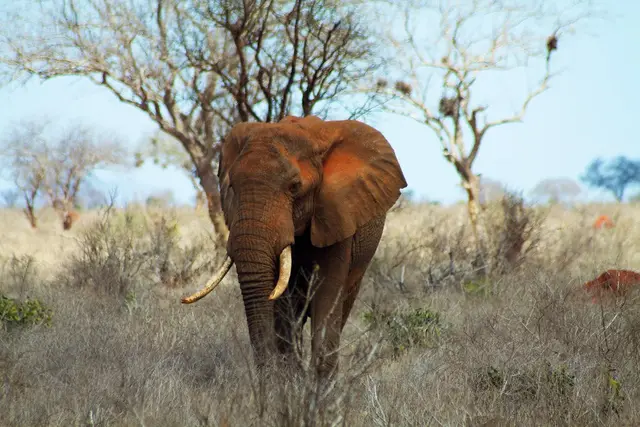
Most safari elephants are grey. Tsavo's aren't — they're a distinctive rust-red, and the reason is almost comically simple: they dust-bathe in the iron-rich volcanic soil that covers much of the park, and it stains their hide the same colour as the ground beneath them. It's one of those small, specific details that makes Tsavo instantly recognisable in photos, and reason enough on its own to add Kenya's largest protected area to an itinerary.
Two parks, one ecosystem
Tsavo East and Tsavo West are managed and gated separately but form a single connected ecosystem — together they make up the largest national park area in Kenya. Tsavo East is the flatter, more open half, known for its red elephants and the Yatta Plateau, one of the world's longest lava flows. Tsavo West is hillier and more varied, with the Mzima Springs — crystal-clear natural springs where hippo and crocodile gather in genuinely startling visibility for East Africa — as its standout feature.
Getting there
Both parks sit conveniently between Nairobi and the coast, which makes them a natural stop on a Nairobi-to-Mombasa or Mombasa-to-Diani itinerary rather than a dedicated detour. Coming from Mombasa via Voi, it's about 96km to the park; from Malindi, around 153km via the C103 road into Sala Gate. The Madaraka Express standard-gauge railway also stops at Voi Station on its Nairobi-Mombasa route, putting you within a short transfer of either park's gates without needing to drive the whole way. For those short on time, flights from Nairobi's Wilson Airport or Mombasa reach several in-park airstrips, including Voi, Sala, Aruba, Ithumba, Satao, and Mopeo.
Fees, current as of 2026
Entry runs KES 1,000 for East African citizen adults, KES 1,350 for Kenya residents, USD 80 for non-residents, and USD 40 for African citizens, with proportionally reduced child and student rates — identical fee structures apply to both Tsavo East and Tsavo West. Tickets are valid for 24 hours from time of entry, giving you flexibility on timing rather than a strict same-day cutoff.
When to visit
Dry season — roughly June to October and January to February — concentrates wildlife around the parks' rivers and waterholes and makes for the easiest driving on Tsavo's dirt tracks. The parks are large enough, though, that even wetter months rarely feel crowded, since visitor density is naturally spread thin across such a vast area.
What else to look for
Beyond the red elephants, Tsavo holds healthy lion and buffalo populations, along with black rhino in protected sanctuary areas within Tsavo West specifically. Birdlife is strong throughout, and the sheer scale of the landscape — endless dry acacia bush broken by rocky outcrops and the odd baobab — is its own kind of attraction, distinct from the greener, more manicured feel of parks like the Mara.
Where to stay
Options range from classic tented camps overlooking waterholes, where game-viewing happens from your own veranda as much as from a vehicle, to more basic self-catering KWS bandas for budget travellers willing to trade comfort for cost. Because the parks are so large, choosing a lodge near the specific area you most want to explore — the Yatta Plateau side, Mzima Springs, or the rhino sanctuary — matters more here than in smaller, more compact parks.
Worth the stop between Nairobi and the coast
If your itinerary already has you moving between Nairobi and Mombasa or Diani, Tsavo is the natural safari stop to build in along the way rather than a separate trip requiring its own dedicated travel days — and the red elephants alone are worth the detour.
A note on planning your route
Because Tsavo East and Tsavo West are gated and managed separately despite sharing an ecosystem, decide in advance which one fits your route best rather than assuming you'll casually cover both — Tsavo East suits travellers heading along the Nairobi-Mombasa corridor via Voi, while Tsavo West suits those routing through Taita Hills or approaching from Amboseli to the west. Trying to do both in a single short visit usually means rushing one or the other, so if time is limited, pick based on whether the red-elephant plains of the East or the springs and hills of the West matter more to you. Bring more water than you think you'll need regardless of season — Tsavo's dust and heat are more intense than the highland parks, and the distances between facilities inside the park are genuinely large.

Comments 0
Join the conversation. No account needed.