

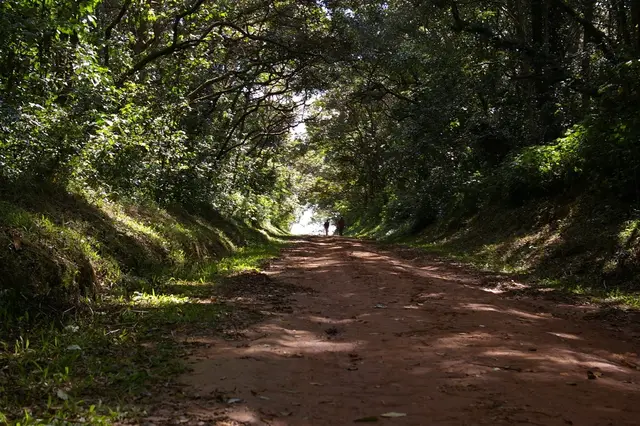
Most first-time visitors to Kenya build their itinerary around savanna — the Mara, Amboseli, Samburu. Understandably. But tucked into the west, a couple of hours past Kisumu, is something the savanna parks simply don't have: Kakamega Forest, the last remaining fragment of the Guineo-Congolian rainforest that once stretched across equatorial Africa. It's humid, dense, loud with insects and birdsong, and about as different from a game drive as Kenya gets. We think that's exactly the point.
Two forests in one
Kakamega isn't managed as a single block, and it's worth knowing the split before you go. The northern section, around Buyangu, falls under Kenya Wildlife Service and edges into more open, savanna-like forest — easier walking, good for a first taste. The southern section, centred on the Isecheno Forest Station, is managed by the Kenya Forest Service and this is the primary forest proper: taller canopy, thicker undergrowth, and the part most serious birders and forest walkers head for. If you only have a day, Isecheno is the better use of it.
The wildlife is the whole point
Kakamega holds seven primate species, including black-and-white colobus crashing through the canopy, blue monkeys, red-tailed monkeys, olive baboons, and the strikingly patterned De Brazza's monkey, which is far harder to find elsewhere in Kenya. Birders come for the numbers: over 360 species have been recorded here, roughly three dozen of which you won't find anywhere else in the country. The Great Blue Turaco — improbably large, improbably blue — tends to be the one everyone wants a photo of, alongside African grey parrots moving in noisy flocks overhead.
Where Kakamega really separates itself, though, is after dark. Guided night walks are the forest's best-kept secret: spotlights pick out bushbabies leaping between branches, tree hyraxes, nightjars sitting stone-still on the trail, and — if you're lucky and quiet — a potto, one of Africa's least-seen primates, moving in slow motion along a low branch. Genets, civets, and glowing fungi round out a walk that feels closer to a nature documentary than a typical evening in Kenya.
When to go
Kakamega gets rain most months — this is rainforest, after all — but two windows stand out as noticeably drier and easier for walking: December to February, and June through August. We're writing this in August, which means if you're reading it this month, you're already inside one of the two best windows of the year to visit. Trails are firmer, the canopy is a little less waterlogged underfoot, and the birding — always good — tends to be more comfortable to do for a full morning. Bring a light rain layer regardless; a sudden downpour is never off the table here, dry season or not.
Getting there
From Kisumu, it's about 90 kilometres to Kakamega Forest, roughly an hour and a half by road along the A1 toward Kakamega town. About 10 kilometres before town, near Mukumu, a signposted turn leads you off the tarmac and onto dirt roads toward Rondo Retreat and the forest station — the last stretch is slow but manageable in a normal saloon car in dry weather. If you're travelling without your own vehicle, take a matatu from Kisumu toward Khayega market, then a boda boda the rest of the way to Isecheno Forest Station. Either way, budget half a day just for the journey if you're coming from Kisumu, and plan to stay at least one night — a rushed day trip barely scratches the surface.
Where to stay
Rondo Retreat Centre, about 2.5 kilometres from the forest station, is the most comfortable base: a converted colonial-era timber homestead set right in the forest, with six cottages and space for around 35 guests. It's run as a Christian retreat centre, so there's no alcohol on the property — worth knowing before you book if that matters to your trip. For a simpler, more budget-friendly stay closer to the walking trails, the Isecheno KEEP bandas sleep up to 21 people across five bandas, and there's a campsite at Isecheno too if you're happy under canvas and want to be woken by birdsong instead of an alarm.
What it costs, and what to bring
Entry fees depend on which side of the forest you're entering and your residency status — community-managed sections charge in the low hundreds of shillings, while the KWS-managed reserve area is priced in USD for non-residents, so carry a mix of cash and check current rates before you arrive since these are periodically revised. A guide is required (and genuinely worth it — you will not spot half of what they will) and is arranged on-site at either forest station. Wear closed shoes with real grip, pack repellent, and don't skip the rain jacket even in the "dry" months.
Worth the detour
Kakamega won't give you lions or a wildebeest crossing, and it isn't trying to. What it offers instead is something most Kenya itineraries skip entirely: a genuine tropical rainforest, still standing, still full of things you can't see anywhere else in the country. If you're already looping through western Kenya — Kisumu, the lake, maybe on to Kit Mikayi — this is the detour that makes the trip.
Comments 0
Join the conversation. No account needed.